This case study was first developed in 2024; the data reflects that timeline.
On a campus of more than 32,000 students and nearly 14,000 faculty and staff, recognizing when someone is struggling isn’t always easy. But at the University of North Carolina at Chapel Hill (UNC-Chapel Hill), the belief is simple: Mental health is everyone’s responsibility.
Founded in 1789 as the nation’s first public university, UNC-Chapel Hill has long been committed to student and employee wellbeing. As anxiety, depression, substance use and isolation have become more prevalent on college campuses nationwide, university leaders saw an urgent need to move beyond awareness and toward action.
Rather than relying solely on counseling services, UNC-Chapel Hill made a bold decision: It would equip its entire community with practical, evidence-based skills to recognize warning signs, start supportive conversations and connect people to help.
The result has been transformative. Since officially launching Mental Health First Aid (MHFA) campuswide in 2022, more than 1,600 students, faculty and staff have been trained — helping shift campus culture from stigma and silence to confidence and connection.
What began as a grant-funded initiative has evolved into a sustainable, scalable model for community-based mental health education — one that is now influencing efforts across North Carolina and beyond.
At a Glance
The UNC School of Social Work Behavioral Health Springboard (BHS) started providing MHFA with a Substance Abuse and Mental Health Services Administration (SAMHSA) grant in 2015.
When grant funding ended in 2021, efforts were made to establish MHFA on campus, beginning officially in 2022. BHS was tasked with implementing MHFA courses across campus. For more than a decade prior, BHS had been working across the state of North Carolina to develop and provide continuing education on evidence-based treatment and interventions to state-licensed mental and behavioral health providers. Since its initial launch, MHFA has played a significant role in shifting the culture around mental health on campus and throughout North Carolina. Today, UNC-Chapel Hill makes MHFA training available at no charge to interested faculty, staff and students.
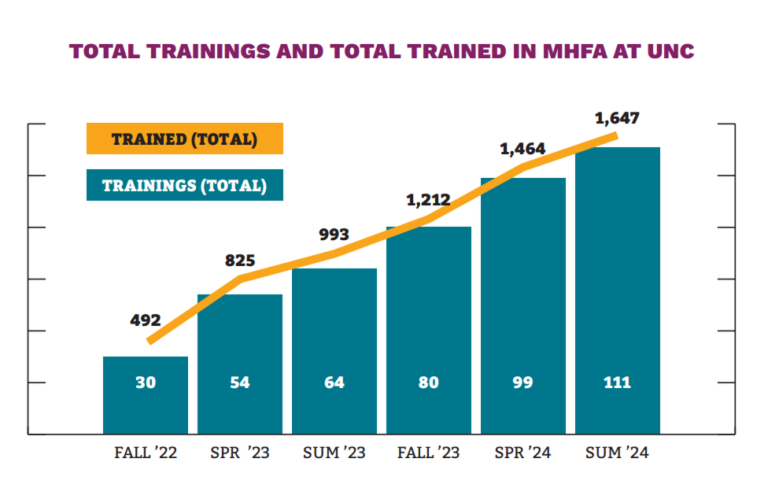
Since the fall 2022 semester, UNC has trained 1,647 people in MHFA.
The success of MHFA at UNC-Chapel Hill is evident in both qualitative and quantitative outcomes. In just a two year period, more than 1,600 people were trained in MHFA.
Program Overview: A Transformative Approach to Mental Health
MHFA is an evidence-based program designed to equip people with the skills to identify and respond to signs of mental health and substance use challenges, offering initial support until the person can access professional help. Initially, MHFA Instructors on campus trained faculty and staff in Adult MHFA (for adults helping adults). Since then, the UNC-Chapell Hill’s MHFA program expanded to include Youth MHFA (for adults helping youth) and Teen MHFA (for teens helping their peers), greatly broadening MHFA’s reach and impact across North Carolina.
“From a faculty and staff perspective, there’s a lot of frontline work that happens in the classroom, where you notice students’ struggles day in and day out,” said Tiffany Edouard, the MHFA Coordinator for BHS. “It’s incredible to be able to not just refer them to an academic counselor but to actually intervene and assess what resources they need. From a student’s perspective, it’s invaluable for conversations with peers, who are often the first to hear from someone in need. MHFA provides a foundational tool that enhances the campus culture for everyone.”
The success here is evident. Many of our Mental Health First Aiders want to return as Instructors, and we’ve heard many stories of people recommending MHFA to friends and staff. Some even want to incorporate MHFA into their curriculum or professional development, which speaks to the program’s value.”
Results of Mental Health First Aid
The success of MHFA at UNC-Chapel Hill is apparent in both qualitative and quantitative outcomes. More than 1,600 learners have been trained in MHFA since the fall 2022 semester, and data shows a marked increase in confidence:
85%
of learners felt confident responding to a substance use crisis.
81.4%
of the population may develop a mental disorder in their lifetime.
98%
would recommend MHFA training to others.
Alicia Freeman, MHFA Program Manager for BHS, noted that the program regularly receives feedback during and after training sessions, including emails from participants explaining how the training has made a difference in their lives.
“A participant in an in-person Adult MHFA training emailed me a week later,” Freeman said. “Her neighbor, a close friend, was going through a tough time. [The First Aider] was able to ask the critical question, ‘Are you thinking about suicide?’ That conversation helped her connect her friend with the necessary support.”
Outside of Chapel Hill, the program has partnered with other UNC institutions and community organizations, training thousands of individuals statewide.
The Power of Private Instructor Trainings
Private Instructor trainings have been a key strategy for scaling MHFA at UNC-Chapel Hill. These sessions bring together small groups (6-16 participants), creating a collaborative and supportive cohort model. This approach ensures Instructor candidates learn together and continue to receive support from BHS and the National Council for Mental Wellbeing, which operates MHFA nationally.
Freeman said, “The cohort model helps us meet Instructor candidates where they are in the learning process. By offering open office hours and check-ins, we provide individualized support and ensure everyone has the resources they need to succeed. […] The camaraderie that forms when they go through the process together strengthens their confidence and builds lasting support networks.”
UNC-Chapel Hill hosted 15 private Instructor trainings in one year — three for Adult MHFA, eight for Youth MHFA and four for Teen MHFA — certifying nearly 200 new Instructors.
Clinical Assistant Professor Karon Johnson, an Adult MHFA Instructor, recalled her own experience in one of these cohorts, saying, “My Instructor training for Mental Health First Aid was wonderful. It took place over three days here in the School of Social Work. The Instructors from the National Council were patient, engaging and funny. I loved learning alongside the cohort, and I felt inspired and encouraged to try the techniques we were learning. It was a great model for how we could later implement these strategies in our own teaching.”
Building a Sustainable Program: Funding and Partnerships
The success of UNC-Chapel Hill’s MHFA program has been fueled by diverse funding sources and strategic partnerships. Freeman emphasizes the importance of collaborations, both on campus and in the community, to ensure long-term sustainability.
Key partnerships, such as with the UNC Suicide Prevention Institute, have integrated MHFA training into the university’s broader suicide prevention efforts. The program has also collaborated with departments like the School of Nursing and School of Social Work to train faculty and staff who can offer MHFA courses within their own areas.
With private Instructor trainings, UNC-Chapel Hill has been able to train large groups at once, ensuring a steady flow of qualified Instructors and allowing the program to scale rapidly and ensure quality.
Looking Beyond UNC-Chapel Hill
The success of MHFA at UNC-Chapel Hill has sparked a broader movement across North Carolina, with a $4.6 million investment from the state to expand the program into communities with unmet needs. The private Instructor training model has been essential to this expansion.
Freeman and her team are focusing on extending the program’s reach beyond the university, particularly to rural and tribal areas. The goal is to create a comprehensive support system for mental health, integrating resources for faculty, staff and students at all levels of the community.